Introduction
This is a brief introduction to Daoist Meditation and to the nine lessons in Daoist meditation that will be presented in the next pages. Meditation is an important part of internal arts training, and Daoist meditation methods are interwoven with the Nei Gong methods that form the foundation of the internal martial arts. So the importance of understanding something about Daosim and Daoist meditation cannot be overstressed.
I first encountered Daoist (Taoist) meditation as part of martial arts training, specifically in the internal art Xing Yi Quan. When learning Xing Yi Quan, the student employs breathing, intention and posture to engage with the movement of the vital force and breath through the central meridians of the body. In this way, one learns to relax while developing a subtle flexible power for combat. At the same time, the mind must be empty, without thought and intention, in order to let the vital force move unobstructed through the body.
During the early years of my study of Xing Yi Quan, much of what various teachers told me seemed abstract and contradictory. The body should move but spontaneously, without thought and intention, but at the same time we were taught specific exercises utilizing breath and movement to facilitate this spontaneous movement. It seemed impossible to perform exercises that employed very specific intention in order to have “no intention”, and to perform very specific controlled movements in order to generate spontaneous movement. When I mentioned this dilemma, the answer was an exasperated “keep practicing.” I did keep practicing, and in time watched spontaneous movement occur in my own body as though I was an outside observer.
Similarly, the imagery used in Daoist texts is confusing and often seems to be contradictory. Yet within the contradiction, within the imagery and symbolism, lies a means of bypassing the ordinary mind, a means of going beyond the ordinary movements of body and mind to engage with a deeper internal movement, a deeper part of oneself.
Daoism started in China’s pre-history and over the centuries has had a profound influence on all aspects of Chinese culture. Literally meaning the “Path”, or the “Way”, Daoism (particularly in the West), is usually associated with the writings of Lao Zi (Lao Tzu), the author of the Dao De Jing (Tao Te Ching), and Zhuang Zi (Chuang Tzu). Their works and the teachings that flow from them are often erroneously referred to as “Philosophical Daoism.” However Daoism, like many things Chinese, is rooted in practicality. Dao or “Way” as a philosophical idea was not just concerned with abstract questions about truth and reality, but with patterns of human behavior and practical knowledge.
Daoist meditation has much common ground with Buddhist methods of meditation such as Zen, Yoga methods of meditation and breath control, and popular meditation practices such as Vipassana. It is not surprising then that Daoist Meditation has sometimes been called “Daoist Yoga.” Through the centuries, there has been an interpenetration of Daoist, Buddhist and Confucian ideas. Daoist ideas influenced the development of Chan Buddhist meditation methods, and these methods, later, in turn contributed to Daoist meditation practices. Despite these crossovers, Daoist meditation retains its own unique methods and goals.
In Daoism there are many kinds of meditation: all involve clearing the mind of distractions and focusing the mind-intention in some way. Many people today are familiar with Qi Gong exercises which involve coordinating the mind-intention with the breath and movement. These methods are used to promote health and rejuvenate the body. Daoist meditation, sometimes called Nei Gong or “inner exercise”, is often considered to be more efficacious in replenishing the vital essences of the body and was traditionally seen as a kind of internal alchemy that changed the body from the inside-out. These practices were employed by many adepts as a means of attaining so-called physical “immortality.”
The premise of much of Daoist meditation is that as people interact with the world, they do so on the basis of their desires and emotions, intellectual distinctions and appetites. As a result, they activate and expend their vital essence and begin to lose their primordial Qi or vital force. As they expend essence and Qi, they decline, become sick and eventually die, often not even living out their allotted lifespan. Healing then, means that there is a recovery of essence and a replenishing of Qi.
Promoting longevity is the next step. Once a state of good health is achieved, Daoist longevity practices, known collectively as Yang Sheng or “life nourishing” methods, can be employed to replenish one’s primordial Qi to – and even beyond – the level one had at birth. This allows people to attain their natural lifespan and live to old age in good health. The Daoist idea of immortality is a step beyond, an attempt to transform all of one’s Qi into primordial Qi, and ultimately refine it to become spirit, eventually becoming transcendent and by-passing death.
In fact, some early Daoists like Ge Hong (283-343 CE) urged the necessity of prolonging life and becoming immortal by laborious action and the employment of a wide variety of techniques and methods throughout one’s lifetime. Whether such immortality is possible is a matter of some debate, but regular practice of Daoist meditation has been shown to improve the body’s health and functioning, on both the physical and mental levels: mental acuity, health longevity, vigor, sexual potency, emotional balance.
How does meditation accomplish this? By attaining a state of quiescence, of stillness, where one regains connection with the primordial energies. Wang Chuan Shen, a philosopher in the Ming Dynasty, explained this succinctly when he said: the quiescent state is actually quiescent movement. It is not motionless. Therefore quiescent exercise is essentially quiescent movement. So entering the quiescent state is essentially quiescent movement. It is movement within stillness. This movement within stillness is different from ordinary movement and can bring about physiological changes: one of which is that energy consuming processes changes to energy storage.
Daoist meditation also focuses on the breath as one of the key elements in engaging with this movement within stillness. Breathing exercises (Tu Na), are some of the oldest recorded medical exercises in China. Regulating the breath is an indispensable part of meditation, Daoist alchemical longevity practices, and health-promoting exercises such as Qi Gong
Meditation, which focuses on quiescence or “movement within stillness”, is often viewed as being a compliment to movement-based exercises, such as Tai Ji Quan (T’ai Chi Ch’uan), and Ba Gua Zhang, moving Qi Gong exercises, and other movement-based exercise systems. By practicing both movement within stillness and stillness within movement, a balance is created. Da Liu, a well-know Tai Ji exponent, expresses this dynamic in the following way:
T’ai Chi Chu’uan and meditation should compliment one another. The relationship between them manifests a subtle interweaving of opposite (yin and yang) tendencies. This relationship can be seen in the famous diagram known as the T’ai Chi Tu (Diagram of the Supreme Ultimate). This diagram consists of two fishlike figures within a circle: one black, and the other white. T’ai Chi Ch’uan, essentially a form of movement is yang, the white fish. Meditation, which involves standing or sitting quietly, is yin, the black fish. But this distinction takes into account only the external aspects of the two activities. To perform T’ai Chi Ch’uan exercise correctly, one must be very peaceful and quiet inside while executing correctly the externally visible movements. Conversely, the meditator must use the breath and the mental concentration to move the vital energy through the psychic channels while remaining externally at rest. Thus the inner aspect of each of these practices is opposite its outer aspect, just as the white fish contains a black circle or “eye”, and the black fish, a white circle.
Bodhidharma (Da Mo), a Buddhist monk from southern India who traveled to China in the early 5th century, had a similar viewpoint. Bodhidharma is credited with transmitting Zen (Chan) Buddhism to China. Legend has it that after noticing that many of his students were so weak and sickly that they fell asleep during meditation, he created exercises to strengthen their bodies and their concentration. These exercises are believed by some to be the forerunners of the Shaolin martial arts.
Methods of Daoist Meditation
There are many methods of Daoist meditation. They can be done standing, sitting, or lying down. So-called “sleep exercises” associated with the 10th century sage and “immortal” Chen Tuan, involve lying on one’s side in a near catatonic state.
Taoist meditation can involve focusing the mind inwardly or outwardly:
- Focusing the mind on body parts or on the internal organs
- Following the breath with the mind
- Counting breaths
- Visualizations of light, colors or beautiful objects
- Focusing on objects in nature such as trees or water
- Absorbing the energy of the sun or the moon by meditating at certain periods of the lunar or solar cycle
- Feeling or visualizing the breath and qi moving through the meridians
- Focusing on, or “holding fast to The One – “experiencing the mind within the mind” while revolving the breath through the body.
The Nine Lessons
In these nine lessons we will explore meditation methods that focus on the breath, the movements of the internal body, and on inner stillness. We will also explore some methods of standing meditation as a means to get in touch with this intention-less state through the alignment of the body, through relaxing the body’s tensions, and by dissolving blockages that hinder and interrupt the flow of qi or vital force. Finally, we will explore meditation as a kind of internal alchemy that rejuvenates and replenishes the body’s innate energies.
These methods have been used for over two millennia by Daoist adepts to promote and prolong life. The trajectory of this text will follow the methods listed above, culminating in the Golden Fluid Returning to Dantian Nei Gong – a unique internal exercise that combines ancient tao yin (guiding and leading the qi) health exercises with Daoist alchemical meditation. Each lesson builds upon the previous lesson, but can also stand alone as its own practice method. Thus the nine lessons do double duty, giving a step-by-step progression, while at the same time providing you with a toolbox of different practices that can be used in different situations.
Each lesson contains both practice exercises and discussions of relevant topics to flesh out the reasoning behind the various methods of meditation, and to help the reader/practitioner more deeply understand the principles and theories that underlie the practice. Rather than hitting the reader with the theory behind the practice all at once, relevant theory is discussed with each lesson, building on the previous lesson. In this way, key concepts are repeated and approached from a variety of angles, making them easier to assimilate.
Your Meditation Toolbox
There is no one method of Daoist meditation, yet all methods have a common thread. In the lessons ahead you will learn a number of variations of the practice of Daoist mediation. Although there is a clear progression – each lesson preparing you for the ones that follow and each building upon what came previously – one method is not better than another. Each method is like a tool in a toolbox. The tool may be more or less useful at certain times, or in certain circumstances. Some methods can easily be done sitting on a crowded bus, others require a quiet space in which to practice. Each method approaches the same goal in a different way. You may want to spend more time with some of the lessons than others, or continue with the practice method in one lesson even as you begin to work on the next lesson. You may want to use one method in the morning and another at night. Remember there is no one correct way or progression. Follow the progression and the guidelines, but do so in a flexible and practical manner.
Romanization of Chinese Characters
When using Chinese terms in an English text, it is easy to forget that they are a Romanization of pictographs or Chinese characters. The Chinese read the pictographs, they do not use Romanization methods such as pinyin to write. Romanization helps westerners to learn Chinese and can a basic understanding of speech and pronunciation. Therefore, there is ultimately no one way to Romanize a character. Different methods have been used in the past and convention often dictates which Romanization method is used in a specific case. For example, the martial art Tai Ji Quan is most often known to Westerners as “T’ai Chi Ch’uan”, or just Tai Chi Chuan; Qi – often mistranslated as “energy” – is often written as “chi”, and Daoism as “Taoism”. There are many debates about this in scholarly circles, but for purposes of this book we will use pinyin, the method officially adopted in mainland China for the Romanization of Mandarin. The following is a short list of terms and names that will appear in the text. In most cases the first appearance of a Chinese word or name will feature both spellings.
Pinyin & other Romanization Methods
Qi = Chi or Ch’i
Qi Gong = Chi Kung
Dao; Daoism = Tao; Taoism
Tai Ji Quan = Tai Chi Chuan
Ba Gua Zhang = Pa Kua Chang
Xing Yi Quan = Hsing-I Chuan
Dan Tian = Tan Tien
Dao Yin = Tao Yin
Jing = Ching
Lao Zi = Lao Tzu
Zhuang Zi = Chuang Tzu
Dao De Jing = Tao Te Ching
Wu Ji = Wu Chi
It is also important to keep in mind that because Chinese is a tonal language, Romanized words that are spelled the same are often actually two different words represented by two different Chinese characters. Therefore context is important when trying to understand Chinese concepts through pinyin and translation.
For example:
Jing (Essence)
is a Romanization of the character: 精, while
Jing (Still; Quiescent; Calm)
is a Romanization of the character: 静
Daoist Meditation Lesson One: The Breath
The Importance of the Breath
Breathing “is” life. While we can survive for days without eating, drinking or sleeping, we cannot live for more than a few minutes without breathing. Most of us pay attention to what we eat and drink. We are aware of how food affects our physical and mental well-being, yet we tend to take breathing for granted. Respiration is one of the body’s most basic rhythms. This is why breathing exercises can have profound effects, both physical and psychological, on the entire human organism. Paying attention to our breath is as important as brushing our teeth, getting enough sleep and eating right.
The movements of the diaphragm and ribs in inhalation and exhalation help the vena cava to return blood to the heart. Additionally, as the organs of digestion have direct and indirect attachments to the diaphragm, its piston-like action in breathing aids digestion and peristalsis. Even the kidneys move slightly with every breath. It is no surprise that impaired breathing can have profound affects on the functioning of the internal organs.
The effect of regular practice of breathing exercises had been shown to have a broad range of physiological effects:
- Hypertensive patients practicing qi gong breathing exercises along with drug therapy were shown to have a lower incidence of stroke and were able to reduce drug intake.
- Asthma patients who practiced breathing exercises or qi gong regularly, reduced their medication, and took less sick leave due to lung problems.
- Improvements in micro-circulation were noted in patients who practiced qigong and breathing exercises regularly.
- Several research studies have indicated that breathing exercises can produce beneficial effects on cardiovascular function such as increased cardiac output, oxygen uptake and adaptation to higher altitudes.
- Deep diaphragmatic breathing has been shown to widen the scope of action of the muscles of the diaphragm, freeing the rib cage and enhancing pulmonary ventilation.
- Diaphragmatic breathing rhythmically massages the internal organs and stimulates the brain.
- Slow, deep breathing in a situation previously demonstrated to provoke gastric problems such as tachy-gastria, prevented the development of stomach symptoms and decreased the symptoms of motion sickness.
- Deep breathing allows the body to take in more oxygen and release more carbon dioxide. This leads to many health benefits: a lowering of blood pressure, slowing of heart rate, and relaxation of the muscles.
- Slow, deep breathing has been shown to calm the mind, reducing anxiety and stress and reducing insomnia.
- Slow and regular breathing, below 10 breaths per minute, is known to affect reflex control of the cardiovascular system and to modulate blood pressure. More specifically, lung inflation increases with a decreased breathing rate, thereby stimulating pulmonary stretch receptors.
- Blood lactate levels fall sharply during the first 10 minutes of meditation. Increased lactate is instrumental in producing attacks of anxiety.
It has been clinically shown that slow, regular breathing at a rate of less than ten breaths per minute not only modulate blood pressure, but reverses the vascular pathology associated with hypertension. Regular practice of slowed breathing actually produced a drop in BP of 20-30 points. The Food and Drug Administration approved RESPeRATE, a biofeedback-like device that helps slow breathing in order to treat hypertension. Physiologically this “slow” breathing appears to result in significant and sustained reductions in blood pressure by reducing the body’s sympathetic neural activity and relaxing the muscles surrounding small blood vessels. This allows for a slight dilation of the blood vessels so that blood flows more freely, thereby lowering the blood pressure. The effects have been shown to be cumulative.
The Physiology of Breathing
During inhalation, the diaphragm muscle contracts, causing it to move downwards. Its curved shape flattens, thereby increasing the air space inside the thoracic cavity and decreasing the pressure in the thorax region. This creates a negative pressure in the lungs, allowing the air in the atmosphere around us to come into the lungs. When the diaphragm relaxes on exhalation, pressure in the thoracic region increases and air space is reduced pushing air out of the lungs.
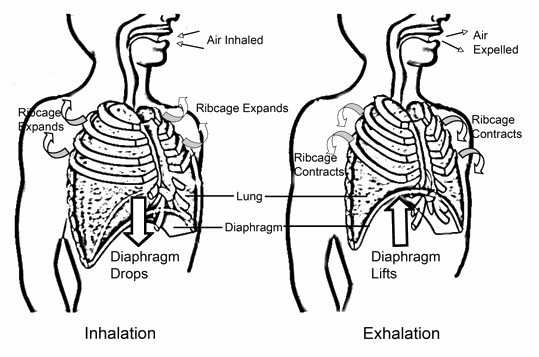
From a structural standpoint alone, this movement has ramifications throughout the body. Although there is little effect on the aorta, these movements act as a pump for the vena cava, assisting return circulation to the heart. Anything affecting the tonus of the muscular fibers of the diaphragm can affect gastro-intestinal physiology due to the connective tissue relationship between the esophagus and the diaphragm. The pleural dome, the connective tissue layer that caps the pleura of the lungs essentially forming the “top” of the lungs, is suspended by fibers of the scalene muscles of the neck and fibrous muscular fasiculi which attach to the thorax. Other surfaces of the pleura attach to the diaphragm, sternum, ribs and vertebral column . Many of the viscera also attach to the diaphragm. The liver, the stomach, and the flexures of the colon coincide directly with the diaphragm, while other viscera have ligamentous connective tissue attachments to the diaphragm. Even the psoas, a deep abdominal muscle that supports the spine and flexes the hip, blends with the crura and other posterior attachments of the diaphragm, all of which in turn blend with the anterior longitudinal ligament that runs up the front of the spine connecting the vertebral bodies and the discs. All of these structures are influenced by the movements of the diaphragm and respiration.
Osteopath Jean- Pierre Barral has shown that the piston-like action of the diaphragm influences the mobility and “motility” of the viscera. In studies involving patients with infectious lung diseases and those treated with therapeutic pneumothorax (collapsing of the lung), he observed that if the lungs and pulmonary system are attacked, the natural axes of rotation of the viscera and the intra-thoracic pressure are changed. Musculoskeletal structures of the thorax may then move along different axes. Such changes can have widespread effects. For example the Kidney moves 3 cm with each breath, which cumulatively amounts to 600 meters per day. With extremely forced respiration it will move as far as 10cm. A minor disturbance in response of the respiration it will move 10cm. A minor disturbance in response of the kidney to breathing can therefore cause a major problem over time.
Respiration oxygenates the blood and expels waste products like carbon dioxide. At a cellular level oxygen is the indispensable key that unlocks the stored energy of ATP. The breaking of ATP’s chemical bonds provides the energy for mechanical work, electrical impulses, cell division secretion, etc. Like a fountain, the living organism retains its improbable configuration by borrowing sources of energy from the world around it and by configuring and reconfiguring organization upon the matter which is ceaselessly flowing through it, and in order to do this, to exploit the energy resources of the substances it borrows from the outside world a cell must have oxygen.
As we shall see, the connection of oxygen and ATP has many overlaps with the Chinese concept of Qi (vital force), which is itself intimately connected with the breath. Sheldon Paul Hendler MD, stresses the importance of ATP:
Without ATP there is no energy, no life. It is ATP that we utilize to act, feel, think. It provides the energy we use every time we “fire” a brain cell, contract a muscle, repair a cell, reproduce our kind. Not surprisingly it takes a lot of ATP to make all of this happen If you are active physically, you are making/using an amount of ATP close to your ideal body weight each day. The body and brain are sensitive to even very small reductions in ATP production. This sensitivity is expressed in terms of aches and pains, confusion, intermittent fatigue and greater susceptibility to infection, and finally, chronic fatigue and persistent illness.
Dr. Hendler suggests that improper breathing can actually result in progressive damage to the heart through the cumulative effect of repeated arterial spasms. Hendler advocates maximizing oxygen flow and ATP production through basic breathing exercises that are the foundation of Daoist meditation (see Lesson 2: Kidney Breathing).
Lesson 1: Practice – Attending to the Breath
Postures for meditation:
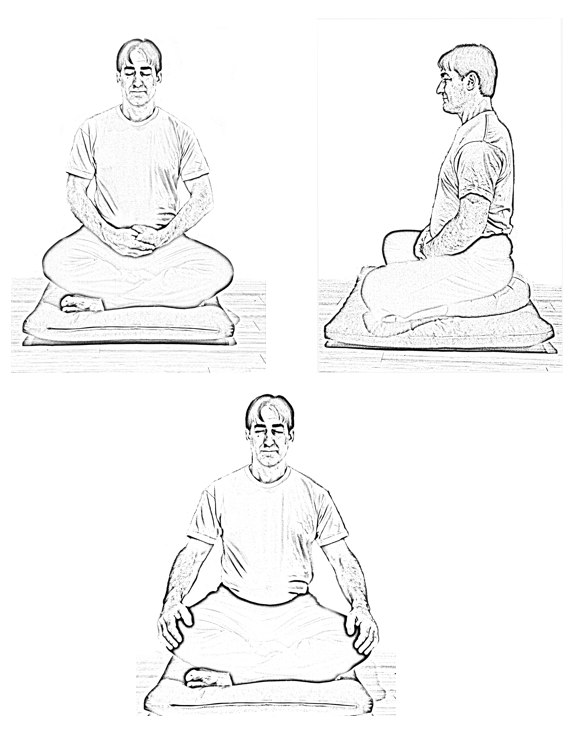
- Sitting cross legged on a pillow
- Sitting on a chair
If you have not meditated before it might be easier to start sitting on a chair as it is easier to set the alignments. Correct alignment is important for the air pathways to open correctly and for the diaphragm to move freely.
When sitting keep the spine vertical with the head floating. The acu-point Baihui (“hundred meeting point”) is at the top of the head in line with the ears. This point should feel as though it is pulled upward while the body weight is released downward into the tail. This creates a gentle traction of the vertebrae, aligning them one on top of the other. Feel as though each vertebrae is stacked and aligned with the ones above and below it.
As you sit, check your alignment. Proper alignment allows the meridians to open and the breath to move without obstruction. Proper alignment relaxes the body, allowing the mind to attend to what is happening inside you and around you.
1) Set Your Alignment
Sitting in a Chair
- The feet flat are on the floor with the knees over the ankles.
- Ideally choose a chair height that allow the knee to be bent 90 degrees and the thighs line up with the hips.
- The hips, knees and feet are lined up.
- The hips must be open and relaxed.
- Ideally sit towards the front of the chair so that your buttocks are on the seat of the chair, but your thighs are for the most part not touching the chair.
- If you feel your back needs support then sit farther back in the chair with a small pillow supporting your low back area.

Sitting on a Cushion
- Make sure the cushion is sufficiently high that the kua (inguinal area) is open is open and the back is straight rather than slumped.
- The hips must be relaxed and open
General Alignments (Chair or Cushion)
- The back is relatively straight from the tail to the vertex – lumbar area relatively flat – not arched.
- The head and upper thoracic spine are lifted while the shoulders drop.
- The head is suspended from the vertex, but draw the chin in slightly in order to lengthen the neck.
- The hands are palm-down on the knees with the elbows bent.
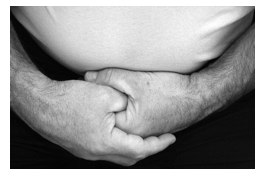
- Alternatively the hands can be palm-up on the knees or enclosed within each other in either a knot-like yin-yang configuration or laid palm up on top of each other with the little finger side of the hands touching Dan Tian.
- Keep space under the armpits as though there is a ball under each armpit.
- Lift the ribs of upper back and drop and soften cthehest muscles.
- Relax and loosen the shoulders.
- Let the tail sink down and slightly under.
- Lift the kua. The kua is the area in the front portion of the hip known as the iguinal area. It must be lifted and open, rather than collapsed or contracted.
- The vertebrae stacked one upon the other.
- Touch the tip of the tongue lightly to the upper palate just behind the upper teeth. This connects two important meridians. We will discuss this in detail in subsequent lessons.
- Relax your face and jaw.
2) Observe the Breath
In the beginning take the time (even one or two minutes) to check your alignment at each practice session. With practice it will become automatic and this process will be very quick.
Read the following as you begin to focus on the breath:
Now that you are sitting in correct alignment, pay attention to the breath.
- Breath slowly in and out of the nose, softly, slowly and without sound.
- Become aware of both the inhalation and exhalation, looking at each individual breath one at a time.
- Pay attention to the flow of air in and out of the nostrils, feeling the movement of air in and out of the nose. Let the breath fill your awareness by noticing the flow of air in and out of your nostrils.
- Thoughts may come and go, you may become distracted, but your attention inevitably returns to the breath, observing it one breath at a time.
- The breath has a rhythm. Observe the rhythm, the inflow and outflow.
- Remember when we inhale, the diaphragm drops creating a negative pressure inside the lungs relative to the air pressure in the atmosphere around us. We do not suck air into our lungs, it enters the nose, and comes into our lungs, seamlessly and effortlessly.
- It takes no effort to breathe, we do it all the time, everyday. Just observe your breath neither emphasizing the inhale nor the exhale – watching, feeling, connecting with the rhythm.
- Notice the space between the inhale and the exhale. When does one end and the other begin?
- Notice the breath without influencing it without judging it, You are just sitting and breathing.
Do this for as long as you like. Try to start with at least five minutes. Although it is best to set aside a practice time each day, this exercise can be practiced anytime and anywhere. If you find the exercise difficult, do it several times a day even for just a minute or two. You can do it on a bus or train or just sitting quietly for few minutes in your office. Each time take a minute or more set your alignment and then focus on the breath. In this way proper alignment will become second nature. Practice whenever you like and notice how the body and mind respond to the practice.
This exercise is the first step, but it is the key step.
Why Nasal Breathing?
- The nostrils cleanse the air and trap dust particles and bacteria
- The blood vessels in the nose warm the air
- The nerve endings of the tunica-mucosa-nasi are stimulated as air flows over them This in turn stimulates the organs and regulatory mechanisms of the body, especially heartbeat, blood pressure and movement of the respiratory muscles.
- There are mall bones in the nose called the turbinates. They are curved boney plates that function like turbines to churn the air as it passes through the nasal cavity, As it circulates, the air is warmed, moistened and cleaned by the reparatory mucosa that cover the surface of the turbinates.
- The turbinate bones increase the surface area of the inside of the nose, and by directing and deflecting airflow across the maximum mucosal surface of the inner nose, they are able to propel the inspired air. This, coupled with the humidity and filtration provided by the turbinate bones, helps to carry more scent molecules towards the higher, and very narrow regions of the nasal airways, where olfaction nerve receptors are located.
- The turbinate bones also create a spiral movement in the airflow. Qi/Breath moves in spirals churning and tumbling through the meridians, vessels and the cavities of the body