The wooden dummy (Muk Yan Jong in Cantonese) is one of the most iconic training tools in Wing Chun kung fu. Often romanticized in films and photographs, the dummy is far more than a striking post or a decorative piece of gym equipment. It is a sophisticated training partner that encodes the entire Wing Chun system—its structure, angles, energy, timing, and concepts—into a single stationary apparatus. Practicing the wooden dummy form (Muk Yan Jong Kuen) correctly requires deep understanding and precise execution. Below are key considerations that separate superficial practice from genuine development.
1. The Dummy Is Not for Power Training (Primarily)
Many beginners treat the dummy as a heavy bag, trying to hit it as hard as possible. This is a fundamental misunderstanding. The traditional Wing Chun dummy is made of teak or similar hardwood and is spring-mounted (either by buried arms in the ground or by wall-mounted slats). It is designed to give realistic feedback through rebound and resistance, not to absorb brute force.
- Striking the dummy with maximum power usually results in jammed wrists, bruised forearms, and poor structure.
- The goal is relaxed, penetrating energy (ging lik) that borrows the dummy’s rebound to recycle force, not muscular power that stops on impact.
- Correct practice develops fa jing (explosive issuance) that feels soft yet travels through the dummy’s trunk.
2. The Form Is a Dictionary, Not a Fight
The 116-movement wooden dummy form (in the Ip Man lineage; other lineages vary slightly) is often described as an encyclopedia of Wing Chun techniques. Almost every hand shape, elbow position, footwork transition, and energy application, and trapping combination appears somewhere in the form.
- It is not a shadow-boxing routine against an imaginary opponent.
- Each section teaches specific responses to pressure from the dummy’s arms, teaching you how to “stick,” redirect, occupy the center, and counter-time.
- Practicing the form slowly and correctly is infinitely more valuable than rushing through it quickly.
3. Body Unity and Rooting Are Non-Negotiable
The dummy exposes structural flaws immediately. If your stance is weak, elbows flare, shoulders rise, or spine is misaligned, the dummy’s arms will jam you or push you off balance.
Key checkpoints:
- Knees must remain inward (Yee Jee Kim Yeung Ma structure preserved even during turning).
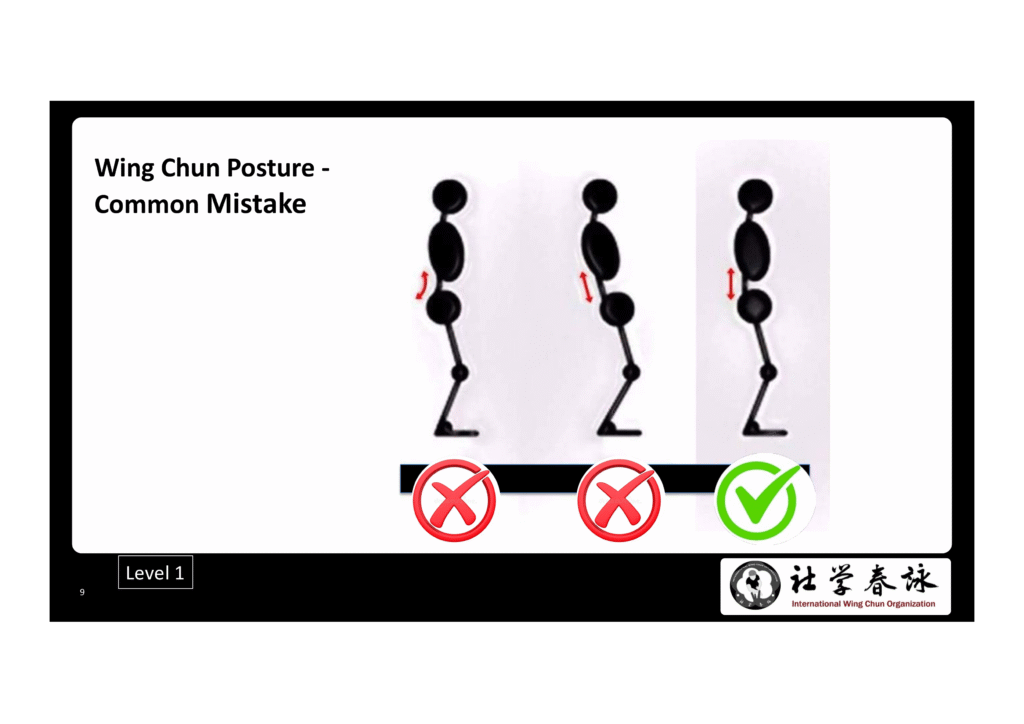
- Pelvis tucked, spine elongated, weight sunk into the heels.
- Elbows should stay on or inside the centerline whenever possible.
- Turning is powered from the stance, not the upper-body twisting.
4. The Arms Are Alive
Advanced practitioners do not treat the dummy’s arms as static obstacles. They imagine (and eventually feel) the arms as pressing, trapping, or attacking with intent. This mental projection turns solo form practice into partner training.
- When you press forward and the dummy arm resists, you must yield, redirect, or dissolve the pressure exactly as you would against a real arm.
- The rebound of the lower arms after a tan sau or bong sau teaches you to “borrow” the opponent’s returning force.
5. Footwork Integration Is Often Neglected
Many students practice the dummy form in a static stance, moving only the upper body. This is incorrect. The original dummy form includes pivoting, stepping, side-steps, and even a kicking section that trains leg attacks and simultaneous hand/foot coordination.
- The dummy teaches you to control distance while your hands are occupied.
- The kicking section (particularly the side kick and front kick while trapping the arms—is one of the few places in Wing Chun where overt leg techniques are systematized.
6. Timing and Rhythm Vary by Stage of Learning
Beginners: Slow, deliberate, perfect structure. Intermediate: Normal speed, focusing on flow and simultaneous attack/defense. Advanced: Broken rhythm, explosive sections mixed with soft yielding, “alive” sensitivity as if sparring.
The highest level of dummy training is sometimes called “playing” the dummy rather than “performing” the form—spontaneous responses to imagined attacks while maintaining Wing Chun principles.
7. Lineage Variations Matter
Different Wing Chun lineages have slightly different dummy forms and dummy constructions:
- Ip Man lineage: 116 movements, trunk with three arms and one leg, usually wall-mounted with slats.
- Yuen Kay-San/Sum Neng: Longer form (around 140–150 movements), different arm positions, often a thicker trunk.
- Mainland/Weng Chun: Sometimes a living-leg dummy that swings freely.
- Pao Fa Lien: Very different arm angles and a heavier, floor-buried dummy.
Understanding your lineage’s specific dummy design and form is essential; techniques that work perfectly on one dummy may feel awkward on another.
8. Common Mistakes to Avoid
- Overextending the arms and losing elbow power.
- Raising the shoulders or leaning forward.
- Treating the dummy like a punching bag (power over structure).
- Practicing only the first half of the form (many students never reach the kicking section).
- Ignoring the dummy in isolation without chi sau and sparring to test the applications.
Final Thought
The wooden dummy form is often said to be the “PhD” of Wing Chun training. Siu Nim Tau teaches structure, Chum Kiu teaches movement, Biu Jee teaches recovery, and the dummy integrates everything while adding realistic pressure and feedback. A practitioner who truly understands the Muk Yan Jong can often express the entire system with minimal movement against a skilled opponent.
Train slowly, train mindfully, and let the dummy teach you rather than trying to impose your will on it. Over years, the dummy stops being a piece of wood and becomes one of the best teachers you will ever have.